Sunday, 18 October 2026
Not by work, But by Faith
Ps Shinoj Joseph Gal 3:14
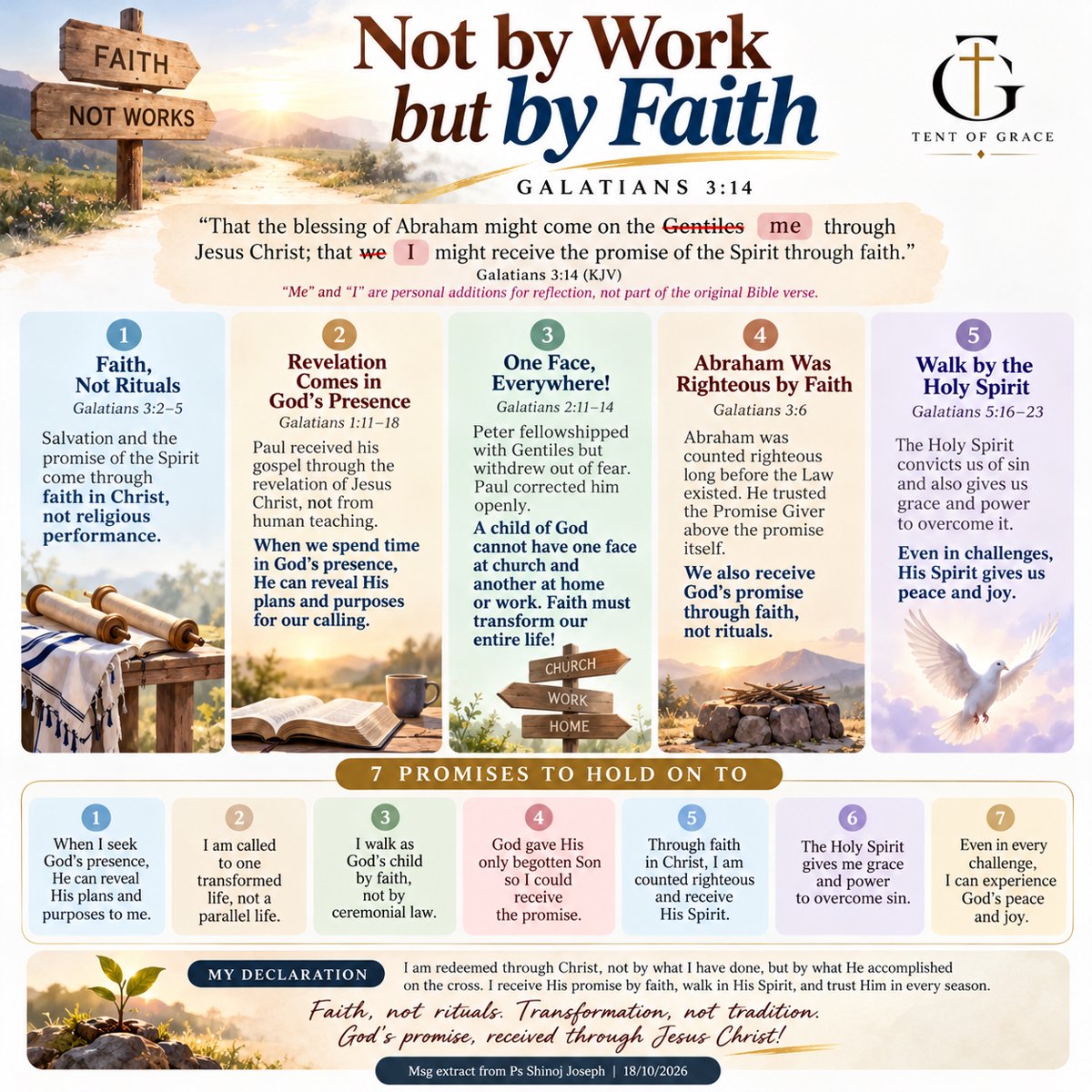
Lessons from Galatians 3:14
Read Galatians 3:14 once as written, then again with your own name in it:
"That the blessing of Abraham might come on ~~the Gentiles~~ me through Jesus Christ; that ~~we~~ I might receive the promise of the Spirit through faith." (Gal 3:14, KJV)
That small change shows what Paul is saying. This promise isn't only for people in a letter written long ago. It's for you.
Why Paul wrote this letter
Paul didn't write to one church. He wrote to all the churches of Galatia, in both the northern and southern parts of the region. Jewish believers had been telling the gentile Christians that faith in Jesus wasn't enough. They said Jewish customs had to be followed for salvation, such as circumcision, special days and months, and keeping separate from gentiles.
Paul is pushing back against exactly that: customs creeping into the church and being treated as a requirement for salvation.
Paul's authority came from God's presence
Some Jewish Christians refused to accept Paul as an apostle, so he explains where his message came from. When he was called to share the gospel, he didn't go to the leaders in Jerusalem. He went to Arabia, led by the Holy Spirit, and received his revelation there. Three years later he met Peter for only 15 days.
So what Paul preached didn't come from a council. It came from the revelations he received in the years he spent in God's presence.
Promise: If you have a calling and are ready to sit in his presence, the Lord is ready to reveal to you. The Lord will give his revelations.
One face, everywhere
In Galatians 2, Paul tells a story about Peter. Peter was the senior apostle, serving among the Jews, while Paul served among the gentiles. Peter visited Paul's ministry and was so excited that he began spending time with gentile believers. For a Jew that was nearly unthinkable, but he did it by grace.
Then James walked in, and Peter tried to change his table position.
Paul stood up boldly and told Peter he cannot have one face in Jerusalem and another in Antioch. As a child of God, he can have only one face.
Principle: As a child of God, you have one face in every place: at work, at home, everywhere.
Principle: God's word can change even a senior pastor. Once we come to faith, we can't live a parallel life. We are called to a transformed life.
Promise: We can step into the new covenant and walk as children of God, not by ceremonial law but by faith and faith only.
It was never the rituals
In Galatians 3, Paul teaches the difference between the Old and New Testament. He asks the Galatians a question that is just as relevant to us today: Is the power of God upon you because of rituals and practices?
No. It comes from the power of the Holy Spirit, which flows from the crucifixion of Christ.
Truth: A true testimony of a child of God isn't built on the practices and rituals I have followed. It was conferred on me because of his crucifixion.
Abraham: righteous by faith
Paul then brings up Abraham, who is a sensitive subject for the Jews. Abraham wasn't counted righteous because of ceremonial laws or letters written on stone. He lived long before Moses and all his rituals. He was counted righteous by faith alone.
The Old Testament is full of tangible things, and we all like having something visible to hold on to. So do we still need faith? Paul's answer is yes.
Think about what Abraham valued most. It was the certificate God gave him, the certificate of righteousness. He received it because he believed the Lord he was serving. He trusted that if God could deliver, then no matter what, he was ready to give back the promise God had given him.
For us, the promise comes at a cost God paid himself.
Promise: For us to step into the promise, the Lord gave his only begotten Son, so that we can step into faith.
Promise: We have also received a certificate of righteousness, the anointing of the Holy Spirit.
Living by the Spirit
In Galatians 5, Paul says to receive the Holy Spirit so that we will put the flesh to death. With the Spirit, we are convicted of sin, and we are also given the grace and power to walk over it.
Promise: With the Holy Spirit, we are not only convicted of sin but given the grace and power to walk over it.
How do you know whether you're living by the Spirit or by the flesh? Paul gives a simple test. Read Galatians 5:19–21 (the works of the flesh) and then 5:22 (the fruit of the Spirit): love, joy, peace, patience, gentleness. If you still see yourself in the first list, you're still walking in the flesh. If you want the Spirit, step into verse 22.
Promise: The life of faith isn't without struggles, but in the middle of any challenge, you can still have peace and joy.
The takeaway
I have been redeemed from rituals and practices. It isn't because of what I have done, but because of the faith we have received through the crucifixion.
Seven promises to hold on to
- If you have a calling and are ready to sit in his presence, the Lord will reveal to you.
- In Christ, you can have one transformed life, not a parallel one.
- You walk as a child of God by faith alone, not by ceremonial law.
- God gave his only begotten Son so you can step into the promise.
- The anointing of the Holy Spirit is your certificate of righteousness.
- The Spirit gives you grace and power to walk over sin.
- In every challenge, you can still have peace and joy.